
Does breastmilk still contain quality nutrients after the first year? Yes! Let’s hit the highlights
Suzanne Sanders here, IBCLC for an article review.
This study titled “A longitudinal study of human milk composition in the second year postpartum: implications for human milk banking” was published online in 2016 and in a peer reviewed journal in 2017 [1]. What I found particularly interesting was the change of nutrient levels in mothers own milk when assessed from 11-17 months postpartum. What nutrients did they assess? Good question.
They measured:
Total protein
Total fat
Lactose
Lactoferrin
Lysozyme
Immunoglobulin A (IgA)
Calcium
Iron
Zinc
Potassium
Sodium
Total HMO’s
Once a month, the 19 participants were instructed to completely express the content of one breast during the first or second feed of the morning. One requirement to be in the study was all participants had to have ‘access to a breast pump’.
After assessing 131 samples from the 19 women who were lactating from 11-17 months postpartum. The authors concluded
“Our study found that human milk in the second year postpartum contains stable or increasing concentrations of macronutrients and bioactive factors, and small decreases in concentrations of zinc and calcium in women who continue to breastfeed or express milk at least three to four times per day.”
Figure 1 gives you a simple visual of these results.
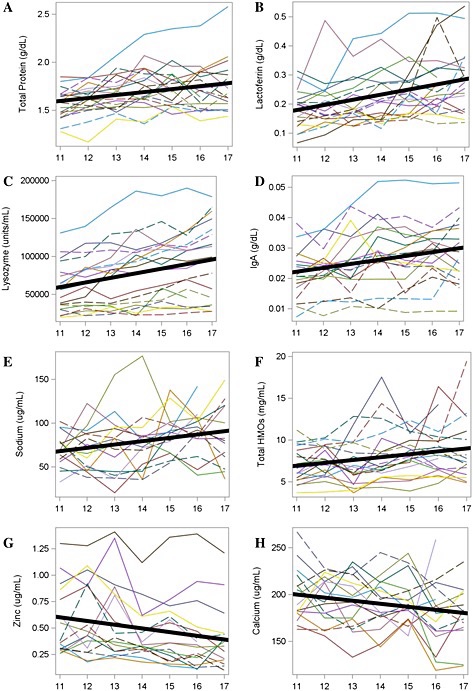
What I found interesting is one factor that predicted a change in nutrient levels was the amount of breastmilk that a mom produced. As the amount of milk that the mother had decreased most of the nutrient concentrations increased.
The authors stated, “this research suggests that volume was a more consistent predictor of milk composition than month of lactation”
The primary purpose of this article was “to describe longitudinal changes in human milk composition in the second year postpartum” to help determine whether expressed breastmilk past 1 year could be eligible for milk bank donation. Here is what this one study concluded:
“Accepting milk bank donations from lactating mothers beyond one year postpartum could increase the supply of PDM (pasteurized donor milk) while also raising the concentration of total protein, lactoferrin, IgA and lysozyme in pooled donor milk; however mineral fortification might be considered.”
Remember, typically research is confirmed in multiple different studies before it has the gumption to impact real world policies. I found this article very interesting, especially in relation to the AAP and WHO recommendations of breastfeeding for at least two years. And, it would be great to see more availablity of pasteurized donor human milk.
If this topic interests you, read the research article and share your thoughts in the comments. I want your input whether you’ve been in the research field for 20 years or whether this is the very first research article you’ve ever read. Just do me one favor, to help me and our other readers further our knowledge, when you comment please include your credentials or experience with reading research.
(You can find my credentials/experience in About the Author)

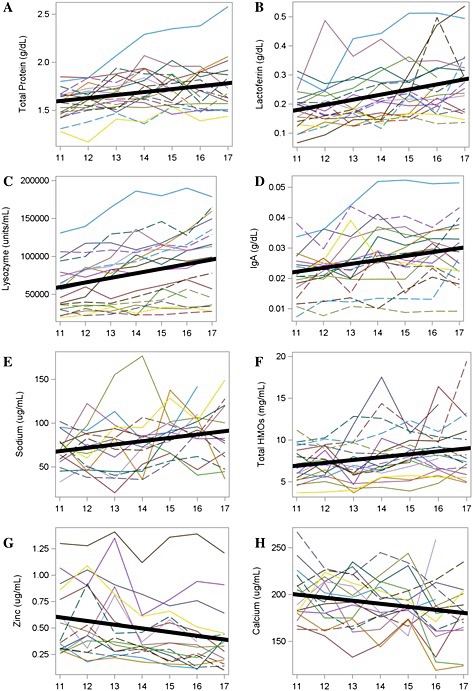
What I learned while reading this research: The Coefficient of determination helps us “judge how well the line fits the data” [2]. So this study looked at nutrients in mothers own milk in relation to the month postpartum the milk was pumped (time-effect) and also in relation to the individual person (subject-effect). When they ran the coefficient of determination for both the time effect and the subject effect, they found that the subject effect was more accurate than the time effect. The dependent variables were more reliant on the subject than on the month postpartum. So I did a dive into coefficient of determination and learned that basically that is looking to determine if the line on the graph accurately represents the data points. See figure 1 again, below. The coefficient of determination is looking to see how far away the data points are from the bold black line, which gives us an idea of how accurate the line is to the actual data [3].
 For Lactation Professionals