
This is a fun one: How maternal food choices alter the flavor of human milk.
Let’s dig in.
This 2019 Systematic Review addresses how flavors transfer to both the amniotic fluid during pregnancy, and breastmilk during the lactation period. (1.) We’ll solely focus on transfer to human milk. There were 3 different methods used to determine if flavors transferred to human milk:
1. Chemical analysis: this can indicate if volatiles of a flavor are present in breast milk.
2. Sensory analysis: this can indicate if volatiles of a flavor are present in breast milk and demonstrate that the volatile is at a concentration detectable by the human olfactory and taste systems.
3. Children’s behavioral response: “Behavioral responses of the children were often videotaped and then measured at a later date by trained study personnel who were often blinded to the hypothesis and conditions except when mothers were asked about their perceptions of whether their child liked or enjoyed the aroma or food that was compared between conditions.” Examples of responses that were assessed: feeding duration, time attached to the nipple, number of sucks, head orientation toward, mouthing, facial expressions of liking, amount consumed, mother’s perception of infant behavior and enjoyment during feeding. These responses were measured either hours after maternal ingestion, or days or months after repeated maternal ingestion. (1.)
15 studies were included in the systematic review regarding maternal diet during lactation.
Very specific flavors were studied. The authors noted that their conclusions were only applicable to the flavors that were looked at:

• Mixed vegetable juices were tested only by children’s behavioral response after repeated maternal ingestion
One important thing to note is that “Conclusions cannot be drawn to describe the relationship between mothers’ diet during either pregnancy or lactation and children’s overall dietary intake.“ (1.) Which means two things:
- From this data we can NOT determine that baby will avoid human milk based on what mom ate. I do not want this to turn into a witch hunt if baby is avoiding breastfeeding, this information does NOT tell us to limit mom’s food choices.
- I want to theorize that if mom eats certain foods the child will be more likely to accept and eat those certain foods when they start eating solids because they are familiar with the flavor and know it to be a safe -not poisonous- option (think way, way back in the day when people were foraging for foods – maybe this helped children determine what was safe). But, we also can NOT jump to that conclusion with the information from this systematic review. Further studies would have to address that theory.
The wild thing is : there is moderate evidence to indicate that some flavors that moms eat will change the flavor of breastmilk! Human milk is so cool.

After reading this article a couple times, here’s a question I still have: How valid are the Sensory Test and the Behavioral Response? Are they accurately measuring flavor transfer?
Sensory Test: Most of the sensory tests seem to involve panelists who smelled samples of breastmilk and then answered questions about, or rated, the scent. The sensory panels included 6-13 adults, with one study using 5 lactating women to taste their own breastmilk.
Children’s Behavioral Response: Here are some examples of behaviors that were assessed to determine if a child/infant recognized a flavor:
- Feeding duration
- Time attached to the nipple
- Number of sucks
- Head orientation toward
- Mouthing
- Facial expression
- Amount consumed
- Mother’s perception of infant behavior and enjoyment during feeding
My guess is that these behaviors could be modified for a number of different reasons, not simply in recognition to a flavor. How did they narrow down the independent variables to determine that these responses were in relation to flavor recognition and not say, time of day when mom’s supply might be lower or higher? I do think the fact that their responses were recorded then analyzed by trained study personal would help reduce the subjectiveness of the evaluations.
It is confidence boosting to see that some of these flavors (alcohol, garlic, carrot, caraway, eucalyptus, fish oil, and fennel-anise-caraway tea) were analyzed by more than one method. For example, alcohol flavor was tested by chemical analysis, sensory analysis and children’s behavioral response. It is also interesting that the timing tended to be consistent as well, regardless of the method used: “The timing of the observed differential behavioral responses coincided with the timing when sensory panels judged the milk to have altered flavor (20, 21,23, 25).” (1.)
The authors of this systematic review did give some studies, like the randomized controlled trials, higher consideration while taking into account the flaws/concerns of other studies. On page 1023S under internal validity, they thoroughly discuss the strong studies in comparison to the studies that received less weight due to possible bias. (1.)
Commenters: What do you know that I don’t? Hit me with your thoughts to my question in the comments. I want your comments whether you’ve been in the research field for 30 years or whether this is the first paper you’ve ever read. By including your credentials in your comment, that helps me and our readers learn together.

What exactly do the authors mean when they say “Conclusion statements related to diet during lactation and flavor transfer and infant detection were determined to be moderate in strength”?
Take a look at this table:
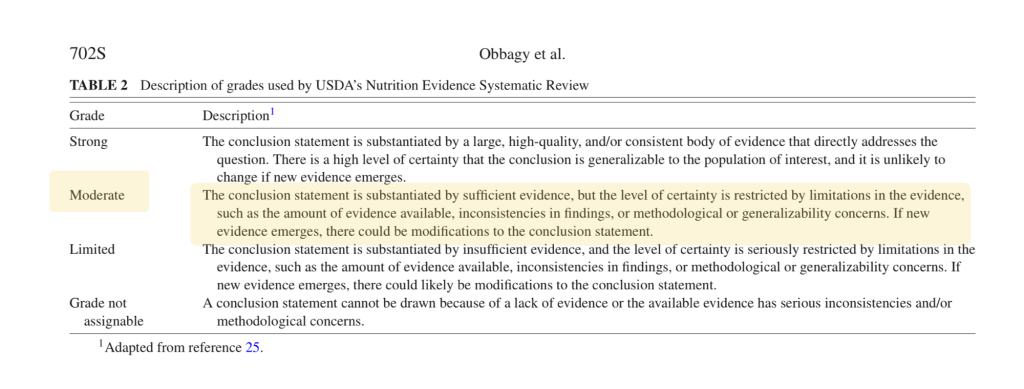
Pretty self explanatory.
This table came from the paper titled “Systematic review methods for the Pregnancy and Birth to 24 Months Project” (2.) Our systematic review that we are discussing today stemmed from the USDA’s Nutrition Evidence Systematic Review team as part of the Pregnancy and Birth to 24 Months Project. Within this project they created a series of systematic reviews and this table came from their paper that discusses the methods they used when creating this series of systematic reviews.
Resources:
- Joanne M Spahn, Emily H Callahan, Maureen K Spill, Yat Ping Wong, Sara E Benjamin-Neelon, Leann Birch, Maureen M Black, John T Cook, Myles S Faith, Julie A Mennella, Kellie O Casavale, Influence of maternal diet on flavor transfer to amniotic fluid and breast milk and children’s responses: a systematic review, The American Journal of Clinical Nutrition, Volume 109, Issue Supplement_1, March 2019, Pages 1003S–1026S, https://doi.org/10.1093/ajcn/nqy240
- Obbagy JE, Spahn JM, Wong YP, Psota TL, Spill MK, Dreibelbis C, Gungor DE, Nadaud P, Raghavan R, Callahan EH, et al. Systematic review methodology used in the Pregnancy and Birth to 24 Months Project. Am J Clin Nutr 2019;109(7):698S−704S.
 For Lactation Professionals