A pilot study comparing traditional flange fit to a new small-size flange fit.

It is exciting to think that there may be new methods for those who struggle with pumping. I’m cautiously optimistic.

Suzanne Sanders here, IBCLC for another article review.

This pilot study “Flange Size Matters: A Comparative Pilot Study of the Flange FITS Guide Versus Traditional Sizing Methods.” was published in November 2024 in a peer reviewed journal. (1)

Before we jump to the results, let’s talk about the method. 36 participants were measured and fitted with two different flange sizes. One flange was chosen based on the Flange FITS method (which is a new, smaller-sized fitting) and one flange was chosen based on the fit instructions from their specific pump manufacturer (standard fitting). For one week, they pumped at least 3 times (averaged 4.62 times) using the standard flange size, and for one week they pumped at least 3 times (averaged 4.71 times) using the smaller flange size. Half the participants were randomly assigned to pump the first week with the standard fit and the following week with the smaller fit, while the other half of the participants did the opposite. They pumped with their own double-electric, non-wearable breast pump. They were instructed to pump roughly the same time of day, at least 2 hours after their last pumping or nursing session.

The study found that those using the standard flange had less milk output and less comfort than when they used the smaller flange.

What I found fascinating were these two graphs: Figure 4 and Figure 5.

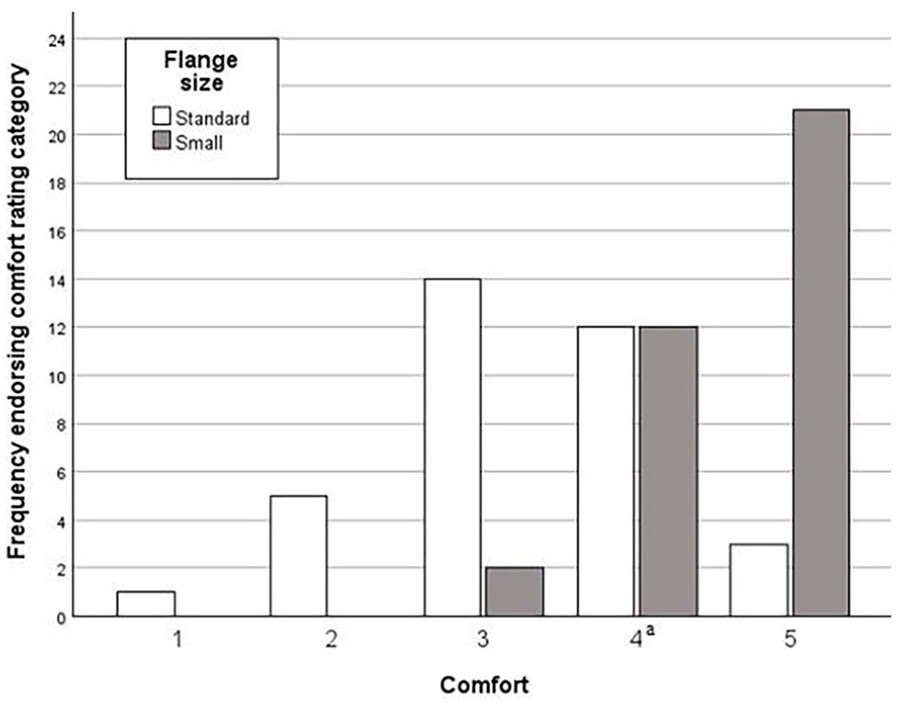
Figure 4 (1)

Figure 4 shows the patients’ reported comfort level. At the end of the week the participant pumped with the standard fit flange, they submitted one comfort rating, and at the end of the week they pumped with the smaller fit flange they submitted another comfort rating. The rating of 5 is ‘very comfortable or feels like nothing’ while the rating of 3 is ‘tolerable’. The average comfort rating for the standard size was 3.3, while the average comfort rating for the smaller fit was 4.5. For your in-the-workforce parent, or exclusively pumping parent, who has to pump multiple times a day, I imagine moving them up 1.2 points on the comfort scale could make a big difference in their breastfeeding journey.

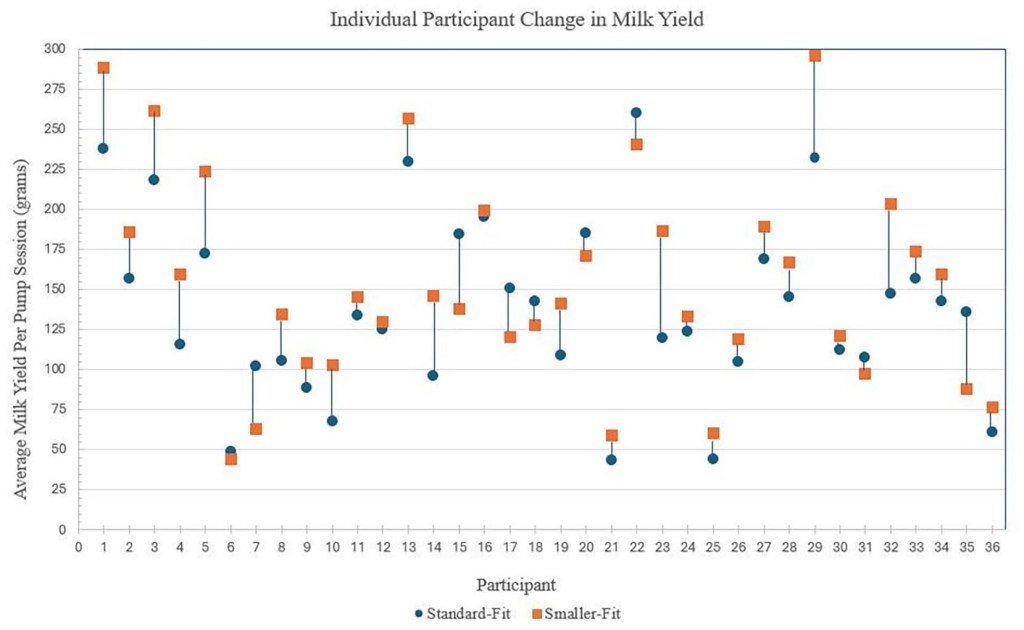
Figure 5 (1)

Figure 5 is also worth a look; this is the change in milk yield between the smaller fit (portrayed by the orange square) and standard fit (portrayed by the blue circle). What I really appreciate about this visual is the nuance amongst individual participants. The mean milk yield for the smaller fit was 153.2 grams, and the mean milk yield for the standard fit was 138.2 grams. You can see in this image that some participants noticed a decent increase when using the smaller fit, while some barely noticed a difference and some noticed a decrease in milk yield.

This study highlights the importance of a flange fitting being “an individualized process led by participant reports of comfort and milk yield.” I think Figures 4 and 5 support this idea. In the supplementary material for this article, you will find a brief guide about how to find the flange sizing for the Flange FITS model. What I find most fascinating about this method is how personalized it is to the individual. It takes trial and error in an appointment and collaboration between lactation professional and the pumping parent. They try multiple different flanges to find which size both produces the best milk sprays and feels the best. My biggest takeaway from this research article is just how personalized and nuanced it is to find the best flange for the individual.

What is important to remember is this is a pilot study, the first of its kind with a relatively small pool of participants. To my understanding, these results need to be replicated by ideally a larger and longer study before we can actually change our current practice and call it ‘evidence-based’. (See my below section What I Learned). Also worth mentioning – there is a very specific method for how the ‘smaller fit flange’ was chosen; it’s called the “Flange FITS” and the guide is free. Hint: it involves actually trying a few flanges out with the patient while they are pumping and collaborating with the patient, so if you’re curious about how to choose the smaller size for your patient: find the guide.

I’d love to hear your thoughts on the article after you read it – post in the comments below and let us know your credentials. I want your input whether you’ve been in the research field for 30 years or if this is your first time reading a research article.

What I Learned : Pilot Studies

I did some digging to learn what a pilot study actually means and what a pilot study can reveal. From my readings, a pilot study is not intended to address a hypothesis. So, pilot studies, in general, are not designed to ask the question ‘Does this intervention work?’ It instead addresses the question ‘Can we perform this experiment?’ When reading and interpreting a pilot study, that’s a HUGE difference. The pilot study can be very helpful when creating a full-scale study by helping to catch and reduce errors and problems that may be encountered in the full-scale study. (3)

One article I read states:

“Pilot studies should not be used to test hypotheses about the effects of an intervention. The “Does this work?” question is best left to the full-scale efficacy trial, and the power calculations for that trial are best based on clinically meaningful differences. Instead, pilot studies should assess the feasibility/acceptability of the approach to be used in the larger study, and answer the “Can I do this?” question.” (2)

The intention is for the nipple tip to ‘glide against the sides of the [flange] tunnel’. Is this going to increase the risk of nipple damage? In this study, there were no reported injuries, but they followed up with the participants after only 1 week of pumping (per flange). What length of follow-up time is needed to determine the safety of this new method?

One other question: In the supplementary material, The Flange FITS Guide states “A thin layer of coconut oil or nipple balm on the bend of the flange can increase comfort.” Do we have any evidence that applying oil or balm to the flange affects -or does not affect- the expressed milk that ends up in the bottle?

References

1. Anders LA, Mesite Frem J, McCoy TP. Flange Size Matters: A Comparative Pilot Study of the Flange FITSTM Guide Versus Traditional Sizing Methods. Journal of Human Lactation. 2024;41(1):54-64. doi:10.1177/08903344241296036

2. “Pilot Studies: Common Uses and Misuses” NIH National Center for Complementary and Integrative Health. Accessed 5/1/2025. Last Updated 5/1/2025. https://www.nccih.nih.gov/grants/pilot-studies-common-uses-and-misuses

3. Kistin C, Silverstein M. Pilot Studies: A Critical but Potentially Misused Component of Interventional Research. JAMA. 2015 Oct 20;314(15):1561-2. doi: 10.1001/jama.2015.10962. PMID: 26501530; PMCID: PMC4917389.

Human Milk Nutrients After the First Year

Does breastmilk still contain quality nutrients after the first year? Yes! Let’s hit the highlights

Suzanne Sanders here, IBCLC for an article review.

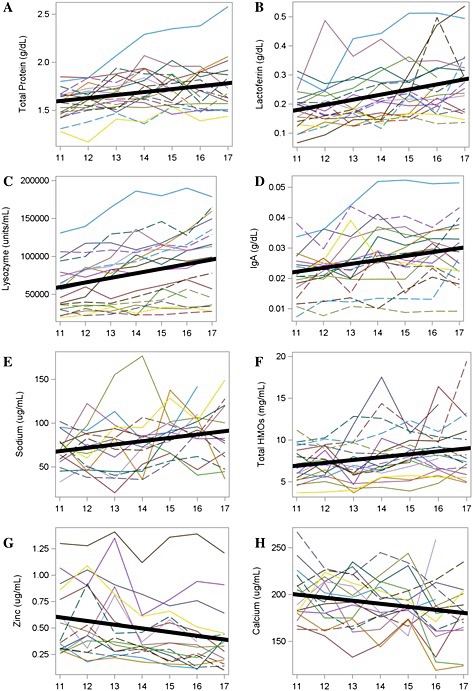
This study titled “A longitudinal study of human milk composition in the second year postpartum: implications for human milk banking” was published online in 2016 and in a peer reviewed journal in 2017 [1]. What I found particularly interesting was the change of nutrient levels in mothers own milk when assessed from 11-17 months postpartum. What nutrients did they assess? Good question.

They measured:

Total protein

Total fat

Lactose

Lactoferrin

Lysozyme

Immunoglobulin A (IgA)

Calcium

Iron

Zinc

Potassium

Sodium

Total HMO’s

Once a month, the 19 participants were instructed to completely express the content of one breast during the first or second feed of the morning. One requirement to be in the study was all participants had to have ‘access to a breast pump’.

After assessing 131 samples from the 19 women who were lactating from 11-17 months postpartum. The authors concluded

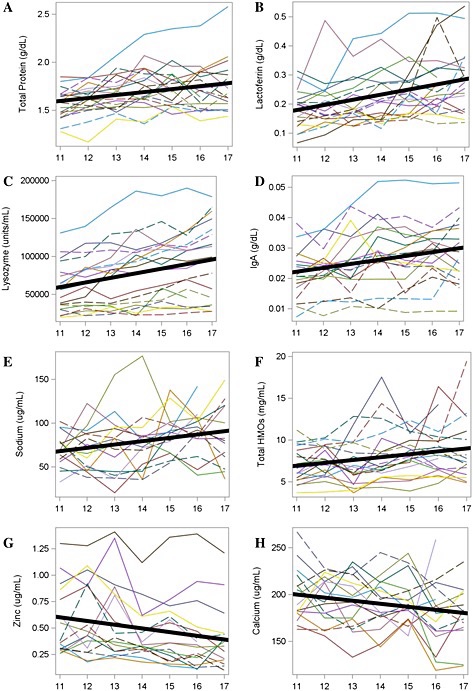
“Our study found that human milk in the second year postpartum contains stable or increasing concentrations of macronutrients and bioactive factors, and small decreases in concentrations of zinc and calcium in women who continue to breastfeed or express milk at least three to four times per day.”

Figure 1 gives you a simple visual of these results.

Figure 1. Perrin MT, Fogleman AD, Newburg DS, Allen JC. A longitudinal study of human milk composition in the second year postpartum: implications for human milk banking. Matern Child Nutr. 2017 Jan;13(1):e12239. doi: 10.1111/mcn.12239. Epub 2016 Jan 18. PMID: 26776058; PMCID: PMC6866067.

What I found interesting is one factor that predicted a change in nutrient levels was the amount of breastmilk that a mom produced. As the amount of milk that the mother had decreased most of the nutrient concentrations increased.

The authors stated, “this research suggests that volume was a more consistent predictor of milk composition than month of lactation”

The primary purpose of this article was “to describe longitudinal changes in human milk composition in the second year postpartum” to help determine whether expressed breastmilk past 1 year could be eligible for milk bank donation. Here is what this one study concluded:

“Accepting milk bank donations from lactating mothers beyond one year postpartum could increase the supply of PDM (pasteurized donor milk) while also raising the concentration of total protein, lactoferrin, IgA and lysozyme in pooled donor milk; however mineral fortification might be considered.”

Remember, typically research is confirmed in multiple different studies before it has the gumption to impact real world policies. I found this article very interesting, especially in relation to the AAP and WHO recommendations of breastfeeding for at least two years. And, it would be great to see more availablity of pasteurized donor human milk.

If this topic interests you, read the research article and share your thoughts in the comments. I want your input whether you’ve been in the research field for 20 years or whether this is the very first research article you’ve ever read. Just do me one favor, to help me and our other readers further our knowledge, when you comment please include your credentials or experience with reading research.

(You can find my credentials/experience in About the Author)

What I learned while reading this research: The Coefficient of determination helps us “judge how well the line fits the data” [2]. So this study looked at nutrients in mothers own milk in relation to the month postpartum the milk was pumped (time-effect) and also in relation to the individual person (subject-effect). When they ran the coefficient of determination for both the time effect and the subject effect, they found that the subject effect was more accurate than the time effect. The dependent variables were more reliant on the subject than on the month postpartum. So I did a dive into coefficient of determination and learned that basically that is looking to determine if the line on the graph accurately represents the data points. See figure 1 again, below. The coefficient of determination is looking to see how far away the data points are from the bold black line, which gives us an idea of how accurate the line is to the actual data [3].

Figure 1. Perrin MT, Fogleman AD, Newburg DS, Allen JC. A longitudinal study of human milk composition in the second year postpartum: implications for human milk banking. Matern Child Nutr. 2017 Jan;13(1):e12239. doi: 10.1111/mcn.12239. Epub 2016 Jan 18. PMID: 26776058; PMCID: PMC6866067.

1. Perrin MT, Fogleman AD, Newburg DS, Allen JC. A longitudinal study of human milk composition in the second year postpartum: implications for human milk banking. Matern Child Nutr. 2017 Jan;13(1):e12239. doi: 10.1111/mcn.12239. Epub 2016 Jan 18. PMID: 26776058; PMCID: PMC6866067.

2. Hamilton DF, Ghert M, Simpson AH. Interpreting regression models in clinical outcome studies. Bone Joint Res. 2015 Sep;4(9):152-3. doi: 10.1302/2046-3758.49.2000571. PMID: 26392591; PMCID: PMC4678365.

3. Khan, Sal “R-squared or coefficient of determination” (video). Khan Academy Accessed April 21, 2025. https://www.khanacademy.org/math/ap-statistics/bivariate-data-ap/assessing-fit-least-squares-regression/v/r-squared-or-coefficient-of-determination.

Suzanne Sanders, IBCLC

On mission to become an extraordinary lactation consultant. Join me?

I want to improve my ability to read and interpret lactation research. I want to shadow and learn from great lactation consultants around the world. I want a better understanding of what concepts in the field of lactation are evidence based with hard research to back it up vs. expert opinion vs. age old wisdom that have been passed down from generation to generation.

A little bit about me.

In 2018 I started off as a breastfeeding technician at a breastfeeding center. There were multiple lactation consultants working at the same office at the same time which proved for a phenomenal learning opportunity. While working there, I earned my IBCLC while shadowing LC’s with different perspectives and different backgrounds. I also shadowed the pediatricians who had their IBCLCs. I had a couple years of working as a lactation consultant at an outpatient pediatric office and a couple years working inpatient at a hospital. Prior to all of this, I had a degree in elementary education and worked a myriad of different jobs in my 20’s while I searched for a career that I loved. Turns out, being a lactation consultant is my dream job.

I am currently in the throws of young motherhood, with a toddler permanently fixed to my side and a baby on the way. I decided it was best for me to step away from seeing patients to focus on caring for these babies during this season of life. While at home, I want to continue learning and growing in my profession. Which is why I started two endeavors:

1. An instagram account called Why Breastfeed to encourage any parents who offer any amount of milk to their little one. And, to discuss the benefits of human milk. I’m hoping by discussing the benefits of human milk and offering encouragement to those on their breastfeeding journey, parents will feel uplifted and energized to continue their breastfeeding journey, even if they are working with a low supply. (Side note: Yes, I’ve heard the argument for research to switch from talking about the benefits of human milk to discussing the risks of formula. Why Breastfeed is for parents, and the last thing I want to do is demonize formula or shame parents, so for this account I will continue talking about the ‘benefits’ of breast milk. However, you may see different verbiage on my blog For Lactation Professionals.)

2. This blog called For Lactation Professionals. Here I want to read and share about research articles that expand beyond simply the topic of “benefits” of human milk. I want to continue learning about the field of lactation. I do realize the best way to become an extraordinary lactation consultant is to actually work with patients, but this season of life I will be focusing on the academia side of things. Outside of my statistics class in college, I have very little education about how to read and interpret research. So, I’m going to learn as I go. I figured the best way to improve is to start by simply reading research articles.

I would love your comments and feedback on my blog posts. To help me learn and our other readers learn, please include your credentials or experience with your comments. I want to hear your thoughts whether you’ve been interpreting research for 20 years or whether this is the very first time you’ve ever read something from a medical journal.

Let’s learn together.

Suzanne Sanders, IBCLC