IBCLC Recertification with Angela Love Zaranka

You have to recertify for your IBCLC every five years and there are two different ways to do it: retake the exam OR certify with continuing education (CERPS).

If you are up to recertify, jump to this podcast episode and you’ll learn everything you need to get started on the process whether you’re gathering CERPS or retaking the exam. Listen to it today if you’re due in 2026. Listen to it this month if you’re due in the next few years, being knowledgeable this month will save you a ton of stress later.

No need to reinvent the wheel here, there’s already a ton of websites with great info on IBCLC recertification… here are some resources that we talk about in our interview.

Websites

IBCLC Commission Prepare for IBCLC Recertification https://ibclc-commission.org/how-to-become-an-ibclc/step-1-prepare-for-ibclc-recertification/

IBCLC Commission Important Dates and Fees https://ibclc-commission.org/step-2-recertification-fees-and-key-dates/

IBLCE Recertification Guide https://ibclc-commission.org/ibclc-information/recertification-guide/

Individual CERPs Guide https://ibclc-commission.org/ibclc-information/individual-cerps-guide/ (How to count educational activities towards your CERPs if they have not yet been recognized as CERPs)

Track your 250 Clinical Hours https://ibclc-commission.org/ibclc-information/lactation-specific-clinical-practice-calculator/

Recertification FAQ: https://iblce.org/?faq-group=recertification 

Detailed Content Outline (to help determine what to study for the exam) https://ibclc-commission.org/ibclc-information/detailed-content-outline/

Login to the IBLCE Portal: https://portal.examstudio.com/default.aspx?ReturnUrl=%2f%3fid%3d500102&id=500102

To keep up to date with IBCLC recertification information and changes go to IBLCE.org and IBCLC-Commission.org

LER blog on recertification: https://www.lactationtraining.com/resources/blog/entry/your-last-minute-guide-to-recertifying-by-cerps (Short, snappy guide. We did not discuss this in the episode, but I, Suzanne, personally found it very helpful. Angela is the program director at LER.)

To learn more from Angela go to lactationtraining.com or email support@lactationtraining.com

Books

*Ensure you get the newest version of the book*

LEAARC; Spencer, Becky and Hetzel Campbell, Suzanne and Chamberlain, Kristina Core Curriculum for Interdisciplinary Lactation Care – This is in outline form and you can go through all of the different topics in the Detailed Content Outline.

Lawrence, Ruth A. and Lawrence, Robert M. Breastfeeding: A Guide for the Medical Profession – If you want to learn more about hospital-based practices and heavy duty medical topics.

Walker, Marsha Breastfeeding Management for the Clinician: Using the Evidence – Phenomenal. Clinical practice

Mohrbacher, Nancy Breastfeeding Answers – Also available via pdf. Highly consider this if you work in the hospital and have less experience with extended breastfeeding.

Wilson-Clay, Barbara and Hoover, Kay The Breastfeeding Atlas – Full of pictures and a very light book

HMBANA Best Practice for Expressing, Storing, and Handling Human Milk in Hospitals, Homes, and Childcare Settings (OR) HMBANA Standards for Donor Human Milk Banking

My conversation with Angela Love-Zaranka covered everything I need to know to feel confident about recertifying. Jump in on our conversation on your drive home from work and learn all about your next steps to recertify for your IBCLC.

2 Very Simple, Very Powerful Documents

I read these two, very short, bullet-pointed documents and learned what I need to adjust when I work with patients. It was very simple and very powerful. When I picked up these documents I thought: dull, boring, dull but necessary. I was wrong. They’re actually very informative: the Clinical Competencies and the Scope of Practice.

Did you know the Clinical Competencies basically lays out what your lactation consultation should include? I mean, not in those exact words, but kind of. If you are in private practice, or have free reign in your consultations to use whatever format you choose, take a look at section III to make sure you are covering the bases in your visits.

And, maybe I’m the only one who has thought this, but when it comes to maternal nutrition while breastfeeding, I’ve wondered, ‘is it within my scope of practice to discuss this, or do I need to punt them off to a registered dietitian?’ (I practice in the US). Turns out “Provide evidence-based information regarding lactation and foods, including their potential impact on milk production and child safety” is in the Clinical Competencies (Section III Develop, Implement and Evaluate an Individualised Feeding Plan in Consultation with the Client 4.)

Which means I have to stay educated and keep abreast of evidence based nutrition guidance for lactating women.

I’m going to assume, someone correct me if I’m wrong, that as long as A) I’m staying educated and keeping up to date with nutrition guidelines; and B) I have a clear understanding of when I should refer to a registered dietitian; then I need to incorporate maternal nutrition into my visits with patients. (After this long maternity leave)

When might be a time for me to refer to a registered dietitian?

  • Maybe if … there is a mom who has a history of disordered eating and whose child is diagnosed with Cows Milk Protein Allergy (she needs to cut dairy from her diet temporarily while breastfeeding)
  • Maybe if … I have a mom who has low supply and is not eating enough calories. I would probably give her advice once, follow up and if she is still not eating enough then send her to a registered dietitian

So. Nutrition is included in my scope of practice. Got it.

Guess what else is included…

In my blog post Tips and techniques I picked up while observing a lactation consultant: Lactation Station and more (https://forlactationprofessionals.com/2025/10/10/tips-and-techniques-i-picked-up-while-observing-a-lactation-consultant-lactation-station-and-more/ ) I admit that I rarely thoroughly assessed infant reflexes, just the basics like the gag reflex. Assessing reflexes of the infant is in the Clinical Competencies (See section III. Skills to Assist Breastfeeding Dyad 3.). That’s an oversight on my part. And that, my friends, is exactly why I am doing this blog and podcast. To go from a good lactation consultant to an extraordinary lactation consultant. An extraordinary LC assesses infant reflexes. Lesson learned. Now I have to educate myself on infant reflexes so that I can competently include them in my future exams. Stay tuned for a post about reflexes down the road.

These documents certainly help to give me clarity on exactly what is in my scope of practice.

I think one reason I tend to second guess myself is that I have worked in both a pediatric clinic and a hospital, where I have worked very closely with physicians, physical therapists, and speech therapists. Not wanting to step on any toes, I found myself asking frequently, is this within my scope of practice? I think this has led to appropriate restraint in some areas, and also too much timidity in other areas. See above. While I did thoroughly assess these documents back when I was initially training to become an IBCLC, I never really thought to look at them again. I now recognize that I need to review these documents more often. Perhaps yearly? And, certainly anytime I ask the question: is this in my scope of practice?

Now… go glance at these 9 pages of documents, it’s quick and easy and bullet pointed. You’ll find both documents under the heading IBCLC Professional Standards here https://iblce.org/about-iblce/bylaws-iblce-documents/

Just to pique your interest, I’m going to include a few bullet points from the documents:

  • Assess social support and possible challenges. (Clinical Competencies III History Taking and Assessment Skills 11.)
  • Support the client to make evidence-based decisions for themselves and their child(ren). (Clinical competencies III Develop, Implement and Evaluate an Individualised Feeding Plan in Consultation with the Client 12.)
  • Providing evidence-based information regarding complementary and alternative therapies during lactation and their impact on milk production and the effect on the child. (Scope of practice III 5.)
  • Assess the child’s growth using World Health Organization Child Growth Standards. (Clinical Competencies III Skills to Assist a Breastfeeding Dyad 24.) See my post all about the WHO Growth Chart. https://forlactationprofessionals.com/2025/06/01/who-growth-chart/

Are there areas in your practice that you are missing? Are there areas in your practice that are outside of your scope?

Suzanne Sanders, IBCLC

Resources

Listen to this podcast episode

WHO Growth Chart

After being a lactation consultant at both a pediatric clinic and a hospital in the United States, I have come to rely heavily on the World Health Organization Growth Chart when assessing adequate growth for littles. A mom comes in worried about her supply or worried about how often (or not so often) baby is nursing, one of the first things I look at is baby’s trajectory on the weight-for-age WHO Growth Chart. As this is such an integral part of my evaluation, I wanted to dig into this tool to learn more about it. I found some fascinating tidbits!

  • They used data from both a longitudinal study that was conducted with babies aged 0-24 months, AND from a cross-sectional study with children aged 18 months – 71 months.
  • The children in these studies were from 6 different countries all around the world. (1.)
  • They had a total of 882 children in the longitudinal study that were followed through 24 months of age. They had a total of 6,669 children in the cross-sectional study. (1.)
  • Some of the requirements for the longitudinal study included: no smoking prenatally and postpartum, no known constraints to growth, breastfeeding: exclusively or predominantly for at least 4 months, and continued partial breastfeeding until at least 12 months with complementary foods introduced by 6 months. (1.)
  • A minimum of any breastfeeding for at least 3 months was the requirement for the cross-sectional study. (1.)
  • This was intentionally created as a ‘standard’, not merely a reference. (1.)
    • Standard = “Since a standard defines how children should grow, deviations from the pattern it describes are evidence of abnormal growth.” (1.)
    • Reference = While a reference shows how children grow in a particular region and time, it “does not provide as sound a basis for such value judgments” (1.)

First off, look at these two tables. They give a good overview of the sheer number of children that were assessed and the various locations world wide.

WHO Child Growth Standards Methods and Development (1.)

What I found so fascinating was the similarity in growth among these healthy children all over the world. No matter what country they were in, their growth was very consistent. Between the consistency of growth in healthy, breastfed babies around the globe and the fact that this was intentionally designed as a standard; this is a really encouraging reminder that the growth charts do give us a strong glimpse into the rate that healthy children grow. After digging into this, I still feel confident in the WHO Weight-for-Age Growth Chart. One interesting comment the authors made at the end of their conclusion is that “…links between physical growth and motor development provide a solid instrument for helping to meet the health and nutritional needs of the world’s children.” Which leads to my question – Should the WHO Growth Chart be used in combination with an a motor development component?

“The MGRS (WHO Multicentre Growth Reference Study) is unique in that it was purposely designed to produce a standard by selecting healthy children living under conditions likely to favour the achievement of their full genetic growth potential.” (1.)

Should I start incorporating the Motor Development Milestones into my assessment?

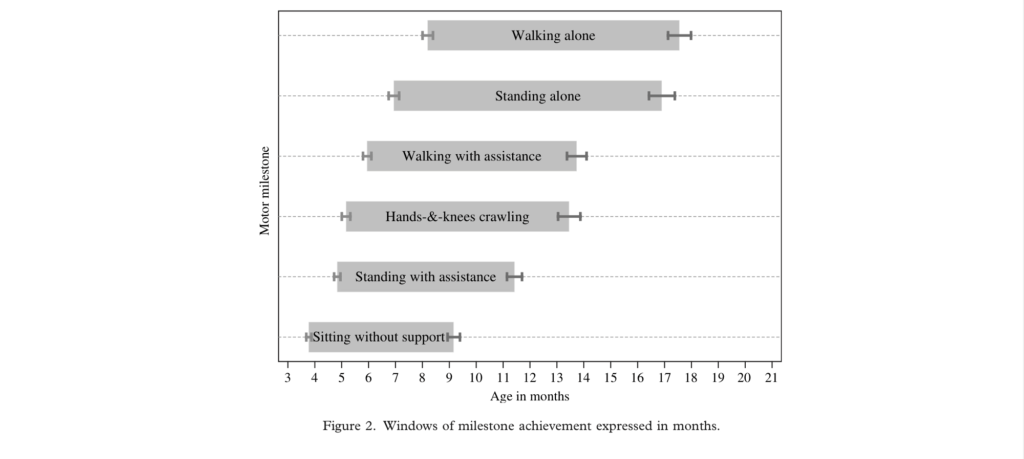
Let’s dig in. Since they reference motor development in combination with physical growth, I wanted to learn more about the Motor Development aspect. Turns out between the ages of 4 and 24 months during the longitudinal study, they looked at the six gross motor developmental milestones of healthy children from 5 different countries around the world. (2.)

  • Sitting without support
  • Hands-and-knees crawling
  • Standing with assistance
  • Walking with assistance
  • Standing alone
  • Walking alone

They then used this data to create a simple, visual scale that depict the age range that these healthy children achieved the milestones. If the child is older than the ‘window’ and not demonstrating the skill, appropriate screening can be pursued. See the figure below.


WHO Motor Development Study: Windows of achievement for six
gross motor development milestones (2.)

What intrigued me was that the earliest ‘age window’ does not close until 9.4 months (sitting unsupported). Which sounds to me like if I wanted to tie this into my assessment, it would give me very limited knowledge until the child being assessed reaches 9 months. Do you incorporate motor development when assessing how your patient is growing?

Since using the growth charts so frequently I inherently had a good understanding of what the percentiles mean. But explaining the percentiles in verbiage that brand new, sleep deprived parents can understand was a bit more challenging. So, I learned a few different ways to explain percentiles. What one parents hears tends to be different than what another parent hears, even if the words are in the exact same order.

  • Looks like your little one has been staying pretty close to the 20th percentile the last few visits. The 20th percentile means that he weighs more than 20% of other boys his age, and less than 80% of other boys his age. Since he is tracking consistently near the same number, that tells us he is growing normally and gaining weight well. (4.)
  • Looks like your little one has been growing consistently near the 80th percentile. Since her growth has been consistently near the same percentile, that tells us she is growing well and gaining an appropriate amount of weight. The 80th percentile means that out of 100 girls her age, she would weigh more than 80 of them. (3.)

This website had some good examples of how to understand and verbalize percentiles:

https://www.pregnancybirthbaby.org.au/amp/article/understanding-baby-growth-charts (4.)

Resources

1. “WHO child growth standards: length/height-for-age, weight-for-age, weight-for-length, weight-for-height and body mass index-for-age: methods and development.” World Health Organization. 2006 Nov. https://www.who.int/publications/i/item/924154693X

2. “WHO Multicentre Growth Reference Study Group. WHO Motor Development Study: windows of achievement for six gross motor development milestones.” Acta Paediatr Suppl. 2006 Apr;450:86-95. doi: 10.1111/j.1651-2227.2006.tb02379.x. PMID: 16817682.

3. “A health professional’s guide for using the new WHO growth charts.” Paediatr Child Health. 2010 Feb;15(2):84-98. doi: 10.1093/pch/15.2.84. PMID: 21286296; PMCID: PMC2865941.

4. “Understanding baby growth charts” Pregnancy Birth and Baby. Australian Government, Department of Health and Aged Care. Last updated May, 2024. Accessed May, 2025 https://www.pregnancybirthbaby.org.au/amp/article/understanding-baby-growth-charts